
| Contamination Control through In-Situ Particle Counting John
M. Hoyte Biography John M. Hoyte is President of Spectrex Corp. and founded it in 1966. During that time he has been involved in developing a Direct-Reading Spectroscope with quantitative attachment, and a range of instruments for environmental control both for air pollution and water pollution. Previously he had worked for Hewlett-Packard as both a process and development engineer and developed a unique line of precision wirewound resistors and a quartz thermometer accurate to 1/1000 of a degree. He has both a BS and MS degree in Engineering from Cambridge University, England.
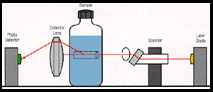
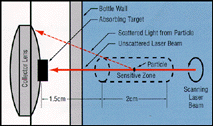
Abstract A unique system for monitoring particle contamination is described which is both easy to perform and effective in execution. The principle of near-angle light scatter is used to count and size contaminating particles in-situ. Parts to be inspected are placed in a container of ultra-pure water and ultrasonicated. A laser directly scans through the glass walls of the container and counts and sizes the suspended particles. The increased counts are directly proportional to the number and size of the particles dislodged from the parts. Key Words Contamination
control Introduction Traditionally particle counting in liquids has been done with flow-through methods. One method uses the change in resistance as each particle passes through a special orifice. The suspending liquid has to be conducting and because of this, the technique is not used extensively in clean-room applications. Another method pumps the liquid through a cell with a light-source on one side and a detector on the other. Each particle casts a shadow as it passes through and the number and intensity of the shadows permits counting and sizing the particles. However, these flow-through methods invariably have problems, particularly with cross-contamination and calibration. The ‘in-situ’ method described avoids these problems and provides a faster and, in many cases, more accurate method for tackling the problem. The need for reduced particle contamination It has been said and is proving to be relatively true, that every decade demands an order of magnitude increase in cleanliness. Five years ago, being able to detect 1µm diameter particles was considered adequate. In another five years 0.1 µm detectability may well be required. As these requirements get more exacting, the need for closer and more thorough monitoring, of smaller sizes, is becoming increasingly urgent. Moreover, because techniques are inevitably more complex, the costs of maintaining controls skyrocket. Thus there is always the need for the development of simpler, more effective techniques. The "in-situ’ method fits this expectation. Technique The parts to be checked are dropped into a beaker of particle-free, distilled water and ultrasonically cleaned for not more than 30 seconds. The beaker is then placed directly in the "in-situ" particle counter where a laser beam is passed through it to scan the volume for particles. The increase in counts will directly indicate the amount of particles on the surface of the parts. Their size is also measured and displayed on the computer screen and print-out. 1997
Calibration Sealed calibration standards are used. Each standard contains a precise number of NIST traceable polystyrene spheres of known size in suspension and are sealed with inert Argon gas. These standards have a proven stability of more than 10 years and provide efficient calibration within 10 minutes. By having these calibration standards always available, calibration is easy and accurate. Most flow-through particle counting systems have a very real problem with calibration, as a standard solution has to be pumped through the sensing cell. The cell can easily get contaminated from a previous sample and the standard solution, once it has passed through, can never be reused as it has been contaminated. This encourages infrequent calibration and thus loss of control. Moreover, the extra step of "flow-through" sampling increases the chances of error. Establishing Standards At the moment there are two sources for calibration standards, Duke Scientific of Palo Alto, California and the Japanese Rubber Company. Duke has supplied our development team with 0.5 µm, 1µm and 5µm diameter latex standards and JRC with 0.5 µm and 1µm standards. Note: The requirement is for a known number of monodispersed latex spheres in suspension. It is very easy to purchase small vials of monodispersed spheres of indeterminate number but establishing the number per cc is a much more difficult matter and narrows the field of suppliers. We are carefully watching these standards and checking for deterioration with time. We have had over fifteen years of experience with latex spheres suspended in an alcohol/freon mix and they have shown excellent stability. Duke can only guarantee their standards for one year as they use deionized water. The ultrapure water is very active chemically and thus could prove unstable over time. At least initially the Duke and JRC counts agree to 10%. This looks promising, but it will take time to demonstrate stability as compared with our alcohol/freon standards. Normally, "the in-situ" particle counter employs three sealed standards: clean, 1µm and 5µm. In the near future it is hoped that a Duke 0.5µm diameter standard will become available. How the method can be used in practice Calibration Any and all materials and parts entering the clean-room can be checked with the in-situ particle counter. 1. Assembly parts. These usually arrive from the supplier in a specially sealed, plastic container. As described earlier, a representative number are dropped into a beaker of clean water, ultrasonicated and scanned. 2. Clothing. face masks. gloves head covering. plastic bags and foot covering. A specified area is cut off, dropped into the beaker of clean water and processed. It is amazing how quickly this simple procedure is completed and contamination exposed. 3. Clean-room surfaces. A standard sized wipe (6"x6" suggested), is passed along the surface to be examined and then dropped into the beaker of clean water for processing. 4. Automode sampling This is a unique program which is supplied with the unit and permits repeated counting and sizing at intervals of 30 seconds or greater. Thus changes in counts with time can be plotted. Such changes, caused by settling, flocculation, agglomeration or dissolution, can thus be quantified. In our experience no other particle counter is capable of providing such data. Results: A number of successful experiments have been performed using parts for hard-drive assembly. The following is a typical example of results using SPACER RINGS where three separate batches were inspected. The results are given as total number of particles per cc greater than 1 µm diameter. Conclusions A system has been developed whereby rapid precise particle counts can be made in a clean-room environment to monitor the levels of particle contamination of components, fabrics, packaging and fabrics with the minimum of sample handling.
|
Presidents
Message
| Laser Particle Counter | Vreeland
Spectroscope | VOC Monitor / Data Logger | Particle
Size / Count Service

Copyright
© 1998 Spectrex Corporation